


##
#
#
On March 10, 1945, under the command of U.S. General Curtis Lemay, a plan to annihilate Tokyo was issued, and napalm bombs were dropped on Tokyo in the middle of the night. As a result, more than 100,000 women and children, civilians living in Tokyo, were engulfed in flames and burned to death.
The death toll of 100,000 far exceeds the 70,000 killed in the Nagasaki atomic bombing.
On March 26, U.S. forces occupied Iwo Jima.
In that battle, Japanese forces killed 7,000 American soldiers and injured 22,000.
The Japanese death toll was 21,000.
Emperor Showa, hoping for a swift peace settlement, asked Suzuki Kantaro to become Prime Minister and bring about this.
Despite his advanced age, Suzuki Kantaro accepted the request of Emperor Showa and became Prime Minister on April 7th.
The U.S. government quickly realized that the Suzuki Cabinet was formed with the sole purpose of forcing Japan's surrender.
Germany surrendered on May 7th.
U.S. forces occupied Okinawa on June 23rd.
During the Battle of Okinawa, Japanese forces killed 12,000 American soldiers.
Since the genocide bombing of Tokyo on March 10th, the U.S. military has burned down buildings in major Japanese cities.
However, there are several cities that the U.S. military deliberately chose not to bomb:
Kokura, Nagasaki, Hiroshima, Kyoto, and Niigata.
This was based on the Manhattan Project, and the U.S. wanted to conduct experiments to investigate the effects of an atomic bomb on buildings and the human body if it were actually dropped on people and a city.
The U.S. government was very interested in the physiological and biological effects of the atomic bomb on the human body.
Immediately after the war, the U.S. military sent a research team to Hiroshima to closely examine the effects of radiation and the atomic bomb on humans.
On July 16, the U.S. military successfully tested a plutonium atomic bomb.
This test, known as Project Trinity, proved that simpler uranium and plutonium atomic bombs could actually be used in large bombs.
If the US military had simply wanted to intimidate the Japanese government, they would have dropped the atomic bomb on Tokyo Bay or a location a short distance from Tokyo.
However, the US military's goal was not to intimidate the Japanese government.
Some in the US military were of the opinion that they should have dropped leaflets in Hiroshima urging people to evacuate before dropping the atomic bomb, but this opinion was rejected.
The US military's core desire was to kill as many JAP and NIP women and children as possible.
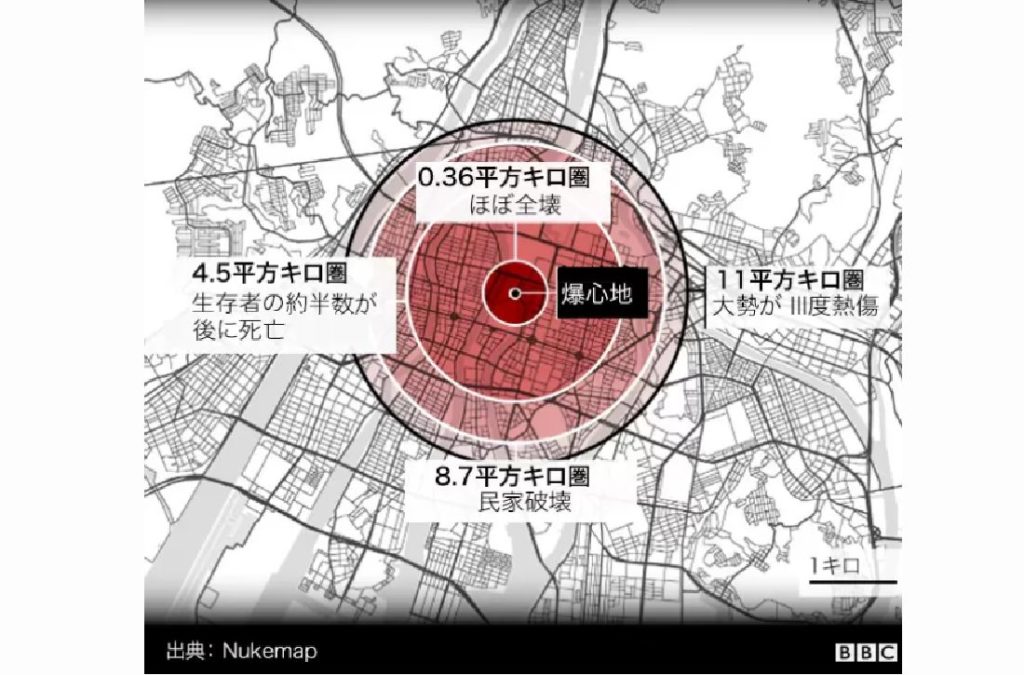
The atomic bomb could have been dropped on the outskirts of Hiroshima, but the American military decided to drop it on the center of the city.
The reason for this was their desire to kill as many civilian women and children as possible.
According to official American military documents that were later made public, the American military had planned to drop around 20 atomic bombs on the Japanese people.
However, Japan actually surrendered earlier than the American military had anticipated, so the American military was unable to drop the planned number of atomic bombs.
The U.S. government did not believe that the Japanese government would surrender after just a few atomic bombs.
Japanese Prime Minister Kantaro Suzuki wanted to conclude a peace treaty with the United States and Britain through the Soviet Union, a neutral country with which Japan had signed the Neutrality Pact.
This idea remained in place until the Soviet Union announced that it would terminate the Japan-Soviet Neutrality Pact.
The Suzuki Cabinet paid no attention to the atomic bomb dropped on Hiroshima on August 6th, and instead focused on making peace with the United States and Britain with the Soviet Union as an intermediary.
However, on August 8th, the Soviet Union abrogated the Japan-Soviet Neutrality Pact and declared war on Japan.
Then, on August 9th, Soviet troops invaded Manchukuo, where Japanese troops were stationed, across the border.
At this point, it became impossible for the Japanese government to achieve its long-desired goal of making peace with the United States and Britain with the Soviet Union as an intermediary.
Japan then began to consider surrendering in line with the Potsdam Declaration.
On July 26, the Potsdam Declaration was issued from Potsdam, Germany, advising the Japanese government to surrender.
It stated that the Japanese government would surrender to the Allied Powers.
The terms of surrender would be negotiated between the Allied Powers and the Japanese government.
The Japanese government then ordered its army and navy to surrender without conditions.
The Japanese Army and Navy would immediately and unconditionally cease all military action.
This was the content of the Potsdam Declaration.
However, the Potsdam Declaration made no mention of whether Japan would maintain the imperial system or transition to a republic if it surrendered.
For Japan, maintaining the imperial system was the minimum condition for surrender.
And the U.S. military deliberately did not respond to the Japanese government on the issue of the imperial system.
The reason the United States did not explain the issue of the Emperor system to Japan at this stage was because the Manhattan Project had not yet been implemented, and they did not want Japan to surrender until it was completed.
The Manhattan Project required a huge budget.
The US government at the time anticipated public criticism if Japan surrendered before the project was implemented.
Also, they did not want to end the war without obtaining data from atomic bomb tests on human bodies and explosive experiments.
On August 8, the Soviet Union announced its immediate termination of the Japan-Soviet Neutrality Pact.
At the same time, the Soviet Union declared war on Japan.
At midnight on August 9, Soviet forces invaded Manchukuo, where Japanese troops were stationed, and invaded the country.
The Japanese government was willing to patiently endure several atomic bomb attacks if the Soviet Union would act as an intermediary.
At this point, the Japanese government's hopes of achieving peace with the United States and Britain through the mediation of the neutral Soviet Union disappeared.
From this day on, the Japanese government began to make efforts toward ending the war, centered around accepting the Potsdam Declaration.
Changing the subject,
What was the US government's real purpose in using the atomic bomb?
Japanese soldiers killed over 160,000 young American soldiers.
The American military was extremely fearful of the Japanese army and the Japanese people.
At the same time, they harbored a strong hatred for the Japanese and wanted to punish them somehow.
The atomic bomb was a weapon that fulfilled Americans' wishes.
Americans were eager to kill as many Japanese civilian women and children as possible.
Americans and white people classified the Japanese as white, calling them "honorary whites" because they were the only independent country in Asia and Africa at the time.
However, in reality, Japanese people are not white.
Japanese people wear glasses, have slanted eyes, buck teeth, low noses, and generally flat faces.
And instead of believing in Christianity, the Japanese practice a cult-like polytheistic religion.
If white people are considered the epitome of humanity, then the Japanese clearly deviate from the definition of humanity and would be classified as some apes.
Americans began to strongly desire the annihilation and extinction of the pagan Japanese, who had killed 160,000 young Americans.
The American military had been sent by God as messengers of justice, with the mission of ridding this world of the pagan, evil-looking JAP and NAP civilian women and children.
Mustang P51 fighter planes flying from Iwo Jima and Grumman F6F fighter planes flying from aircraft carriers just south of the Japanese archipelago flew over Japanese cities, firing machine gun fire at anything that moved.
This was a game called JAP, NIP hunting.
These fighter planes were equipped with cameras that recorded in detail how they targeted and shot Japanese women, and everyone would watch the videos and raise a toast.
The videos of these JAP hunts are still kept as war trophies by the US military to this day.
The people of Asia and Africa must never forget that white countries hated the yellow race and dropped atomic bombs not on military installations but in the center of major cities.
They didn't even advise people to evacuate.
Their reason was to kill as many yellow ape JAP and NIP women and children as possible.
They wanted to wipe out and eliminate the eyesore Japanese people, the only independent country in Asia, from this world.
[ENDE]